How to prepare your 2026 data structures and navigate the transition to IFRS 18 without the solo effort.
In corporate finance and financial reporting, staying ahead of regulatory changes is crucial for maintaining market confidence and efficiency. Understanding the shift to IFRS 18 helps companies ensure global compliance, improve financial transparency, and communicate performance more effectively to investors. In this article, we’ll explore the key pillars of the new IFRS 18 framework and how to streamline your transition without disrupting your day-to-day reporting.
Written by Business Analysts Siebe Vandenbussche and Cato Vanhoutte – Reading time: 2 min.

Setting the Stage
For decades, the flexibility of the old IAS 1 standard gave companies significant freedom in how they reported financial performance. While convenient, it often left investors frustrated by vague “Other” categories and subjective reporting that obscured a clear view of financial health. IFRS 18 addresses these challenges directly. This major new standard, arriving January 1, 2027 replaces vague structures with a highly disciplined, uniform framework designed to eliminate inconsistencies across global financial reporting.
Because the standard requires retrospective application, you must apply it to your 2026 data to allow for a side-by-side comparison when the law hits. The countdown has started, but with BrightAnalytics, transitioning your data structure is smooth and highly automated.
The 3 Pillars of IFRS 18
The new standard fundamentally alters financial reporting across three core pillars. Here is what is changing and how BrightAnalytics streamlines your compliance.
1. The Redesigned Income Statement
The most visible change is the mandatory classification of all income and expenses into five distinct categories, supported by two standardized subtotals.
- Operating: The default bucket for main business activities, support activities, and non-recurring items (like restructuring costs or goodwill impairments).
- Investing: Returns from assets that generate income independently, like dividends, cash-equivalent interest, and joint venture results.
- Financing: The pure cost of raising capital (bank loans, bonds) plus interest effects from other liabilities (leases, pensions).
- Income Taxes: Standard tax reporting.
- Discontinued Operations: Standard reporting for discontinued units.
The Two Key Subtotals: You must now explicitly report Operating Profit or Loss (core operations) and Profit or Loss Before Financing and Income Tax (core operations + investing returns). This allows investors to evaluate asset performance entirely independent of financing decisions.
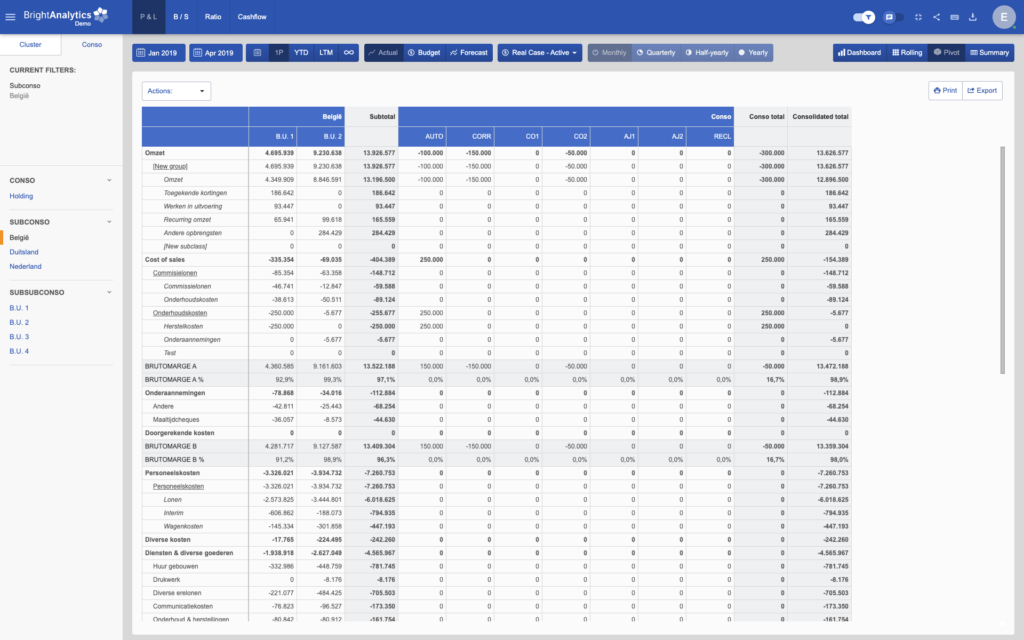
How BrightAnalytics Helps: Restructuring your entire historical P&L structure sounds overwhelming. Because multi-structure reporting is built right into the core of BrightAnalytics, you can map your data to the new IFRS 18 layout while keeping your existing management or local GAAP structures intact. Switch between different P&L views with a single click.
2. Bringing Discipline to “Non-GAAP” Metrics (MPMs)
If your company relies on custom metrics like “Adjusted EBITDA” to tell its financial story, IFRS 18 puts them under a microscope. Any publicly communicated subtotal of income and expenses used by management is now labeled a Management-defined Performance Measure (MPM). Under IFRS 18, MPMs:
- Must be disclosed in a single, dedicated note explaining why the metric is useful.
- Require a clear reconciliation back to the closest official IFRS subtotal.
- Must factor in income tax and non-controlling interest effects.
- Must be used consistently across periods to prevent selective reporting.
How BrightAnalytics Helps: Identifying which custom metrics qualify as MPMs requires a clear look at your existing reporting setup. The BrightAnalytics AI Agent addresses this by evaluating your current income statement structure to suggest the necessary alignments, highlighting which metrics need to be disclosed to keep your transition compliant.
3. Enhanced Transparency, FX, and Cash Flows
IFRS 18 leaves no room for hiding material details in vague groupings:
- Restricting the “Other” label: The use of generic “Other” labels is now strictly limited. If an item is material, it must be broken out.
- Functional Expense Disclosures: Choosing the Cost of Sales method now requires disclosing five specific nature items in a note: employee benefits, depreciation, amortization, impairments, and inventory write-downs.
- FX and Cash Flow Uniformity: Foreign exchange gains and losses must now be split and follow their transaction of origin into the Operating, Investing, or Financing bucket. Furthermore, the Statement of Cash Flows now mandates Operating Profit as the uniform starting point for the indirect method, eliminating the need to adjust for interest or taxes later in the reconciliation.
How BrightAnalytics Helps: Complying with stricter disclosure and FX rules requires deep visibility into your data. BrightAnalytics integrates directly with your ERP system to extract data at the lowest level of detail. This granular foundation gives you the exact data mapping needed to break down operating expenses and track transaction origins effortlessly.
Meet Your Transition Blueprint: The BrightAnalytics AI Agent
Manually auditing your entire chart of accounts to align with these new rules can be a tedious process. That’s why we built the BrightAnalytics AI Agent for IFRS 18 to guide your P&L alignment. Working behind the scenes, this dedicated AI companion simplifies your workflow:
- Analyzes your setup: It evaluates your current chart of accounts and income statement structure to pinpoint the exact changes needed for compliance.
- Predicts the correct alignments: The agent automatically predicts the right placements for the updated categories and mandatory subtotals.
- Provides an actionable blueprint: By generating these automated mapping suggestions behind the scenes, it delivers a clear roadmap for a smooth migration.
- Streamlines the final setup: Lastly, you can check the updated structure again with the agent to ensure it is fully compliant in the application.
Don’t Wait for 2027
To meet the January 1, 2027 effective date, your 2026 data must be restructured retrospectively. Navigating this change doesn’t have to be a solo effort. With BrightAnalytics, you get the best of both worlds: a flexible, AI-powered platform built to automate the heavy lifting, alongside a dedicated customer success team ready to guide you every step of the way. Together, we will help you protect your current reporting workflows while seamlessly adapting to the new global standard.